Comments Off on How to Heal After Sexual Assault with Gail Foss, RN, LADC
In this episode, we are discussing the #metoo movement from the perspective of healing. With us is Gail Foss, RN and Licensed Alcohol and Drug Abuse Counselor, we talk about how she helps women and men heal after experiencing sexual violence. In the interview, Gail opens up about her own experience and tells us a little bit about what needs to be done to change our culture so this doesn’t continue to happen.
In the “Ask Mabel” segment we learn about the Mirena IUD.
Comments Off on Maine Community Leaders Urge Senators Collins and King to Oppose Kyle Duncan’s Nomination
February 15, 2018
Remarks by Andrea Irwin, Executive Director
Mabel Wadsworth Center is an independent abortion provider located in Bangor, and we see clients from as far north as Canada and across Maine. Nearly half of our clients rely on MaineCare (Medicaid) for their health coverage and many others are uninsured and low income. Some of our clients from more rural communities must travel hundreds of miles, often having to manage missing work or school, arranging childcare, and finding gas money, to get here for needed abortion care. We see clients every day whose lives would be harmed if Kyle Duncan is confirmed, and we strongly oppose his nomination.
Kyle Duncan has actively opposed basic reproductive rights; he supported Texas laws that shut down nearly half the state’s abortion clinics. In 2016, in Whole Woman’s Health, the most important case since Roe v. Wade, the Supreme Court found that these laws were clearly unconstitutional. They were not medically necessary and in fact decreased patient safety – by increasing the number of unsafe, self-administered abortions.
The anti-abortion movement has been laser-focused on closing clinics. The Texas laws and many others, known as TRAP laws, or “Targeted Regulation of Abortion Providers” are clinic shutdown laws pushed by politicians, not doctors, under the guise of “patient safety.” Politically motivated legislators in Maine failed to pass a TRAP law in 2015, a law that would have had a detrimental impact on our clinic and our ability to serve our community.
Kyle Duncan even co-authored an amicus brief in Whole Woman’s Health, relying on junk science to argue that prescribed hallway widths and full operating suites were needed to ensure “patient safety”. I, too, played a role in that case and signed on to an amicus brief supporting abortion access – as one of 113 lawyers who had abortions and were able to achieve educational and professional advancement as a result. The 2016 Supreme Court rightly put a stop to the growing tide of these politically-motivated sham laws that undermine the rule of law and distort the reasonable standards established by the Court to protect every woman’s constitutional rights.
If, however, the Supreme Court had relied on Kyle Duncan’s arguments, women’s health would be gravely threatened. For example, a woman in El Paso would have to drive more than 500 miles—or 7.5 hours— roundtrip to San Antonio to get abortion care in her home state.
The clinic closures also caused women in Dallas, the state’s third largest city, to face delays as long as 20 days for their initial consultation for an abortion—up from an average of five days in 2013. This forced more women to delay their care into the second trimester – making it both less safe and more expensive.
These laws create higher costs, longer delays, and extra steps for women seeking abortion care, and in the process punish women for their decision to exercise their constitutional right to end a pregnancy. The only people who should be making decisions that impact women’s health and lives are women themselves and their healthcare providers— not politicians or judges. Regardless of how we feel about abortion, none of us, including Kyle Duncan, can stand in another person’s shoes and understand the circumstances and realities of their lives.
Duncan also has a problematic record with respect to putting the rights of private corporations and pharmacists over patients who need birth control.
Duncan served as lead counsel in Hobby Lobby v. Burwell, where he argued that for-profit corporations should be able to deny birth control coverage to their employees on religious grounds. In the case, he criticized the idea that birth control is “necessary for ‘the good life,’ health and economic success of society, particularly women.” Because of the Court’s ruling in the case, countless women do not have access to basic healthcare.
Duncan fought a Washington state law that required pharmacists to stock the drugs needed “to meet the pharmaceutical needs of its patients,” including birth control. The Ninth Circuit upheld the law, and the Supreme Court refused to hear the case. If Duncan had been successful, women’s access to birth control could have been restricted if they lived in an area where pharmacies refused to stock such products.
We ask Senators Collins and King to oppose his confirmation and commit to holding all judicial nominees to a standard of following precedent and protecting our constitutional rights.
Listen to the full press conference with remarks from Quinn Gormley, Executive Director of MaineTransNet, Laverne Thompson, and Eliza Townsend, Executive Director of the Maine Women’s Lobby.
Comments Off on Providing Abortion Care with Dr. Jamila Perritt
On January 18, 2018, we had the privilege of hosting Jamila Perritt MD MPH FACOG for our annual Roe v. Wade celebration. She spoke about her experience as an abortion provider, shared her story along with stories of the women she takes care of and highlighted why reproductive justice is what we all need to be working toward. (Diazepam)
Jamila Perritt MD MPH FACOG is a board-certified Obstetrician and Gynecologist who specializes in Family Planning and Reproductive Health. Dr. Perritt is a graduate of Howard University College of Medicine and completed her residency training in Obstetrics and Gynecology at Pennsylvania Hospital in Philadelphia, PA. She completed a Family Planning Fellowship at The Johns Hopkins University in Baltimore, MD. During her fellowship training, Dr. Perritt received a Masters Degree in Public Health from The Johns Hopkins Bloomberg School of Public Health. After completion of her fellowship, she returned to her hometown of Washington, DC where she served as the Medical Director at Planned Parenthood of Metropolitan Washington DC, Inc. from 2011-2016.
Dr. Perritt works as a clinical provider in Washington, DC, Maryland and Virginia. Additionally, she serves as a reproductive health care consultant where she develops, organizes and facilitates health education workshops and outreach events to diverse communities and community partners on topics including but not limited to HIV/STI treatment and prevention, reproductive justice and access to care, adolescent health, contraception and family planning. She collaborates with various organizations to provide ongoing support and subject matter expertise on sexual and reproductive health, family planning and reproductive justice.
There wasn’t time for “Ask Mabel” in this episode. Listen next month as we continue to share women’s experiences with birth control.
Comments Off on Letter to Our Senators: Please Oppose S. 2311
January 23, 2018
Dear Senator:
I strongly urge you to oppose S. 2311, the so-called “Pain Capable Unborn Child Protection Act.” As Maine’s first public abortion provider, Mabel Wadsworth Center has helped women across Maine access important reproductive health services, including abortion, since 1994. We know firsthand how important abortion care is to our region and the impact access to safe and legal abortion has on our clients.
Located in Bangor, we are the only facility to provide the procedure north of Augusta, meaning that many Women from our state’s most rural Counties, including Aroostook and Washington, come to our clinic for services. As you know, these areas are extremely rural and travel, especially during harsh Maine winters, can be difficult. We currently provide abortion up to 14 weeks and therefore must refer women who may need abortion later in pregnancy to other clinics in Maine and New England.
I firmly believe that S. 2311 would restrict access to abortion care for the women who need it most. In my experience, women who need abortion after the first trimester are more likely to be young, poor and managing challenging circumstances such as domestic abuse, sexual assault, drug dependence, among others. If a woman is involved with an abusive partner, for example, she could be subjected to reproductive coercion, the practice of controlling and the term used to describe behaviors that are used by an abuser to control a woman’s reproductive health and options. These behaviors vary but could include sabotaging her birth control method; forcing someone to continue an unwanted pregnancy; or prevent you from choosing whether or not to continue a pregnancy. Rather than protecting women’s health, this bill would punish women who are already vulnerable.
Just recently, I counseled a young woman who was unexpectedly pregnant and seeking an abortion at our clinic. Her long-acting birth control method failed but she didn’t exhibit any typical pregnancy symptoms. As a result, she didn’t realize she was pregnant until she was 23 weeks. This 19-year old worked at a minimum wage job and was hoping to save money in the future to go to college. For many reasons, she did not feel ready to parent, so we helped her find a way to get an abortion at another facility out of state. She couldn’t tell any of her family members and doesn’t even have a driver’s license. This facility was more than five hours drive from her home and would cost more than three times the amount it does at our clinic. Despite these barriers, she was determined not to continue this pregnancy and found a way to get to the other clinic. She was very clear about wanting a future that included completing her education and finding a good job before becoming a parent.
There are many reasons a woman may need abortion care after 20 weeks of pregnancy. Politicians shouldn’t be making these decisions; they should be decided between a woman and her medical provider. Most women who decide to have an abortion are incredibly clear about their decision; the last thing they need is the government attempting to tell them what’s best.
Unfortunately, cuts in healthcare and other safety net programs make accessing family planning services more difficult than ever. Restricting a woman’s ability to terminate an unwanted pregnancy further punishes poor women who are already facing significant barriers.
I urge you to oppose this bill. It would have major consequences for Maine women and their ability to make the decisions that are best for themselves and their families.
Comments Off on Almost half a century after Roe v. Wade, abortion rights still under attack
By Aislinn Canarr and Andrea Irwin, Special to the Bangor Daily News •
Monday marks the 45th anniversary of the Supreme Court’s landmark Roe v. Wade decision that legalized abortion in the U.S., a historic moment for women’s advancement. Despite nearly a half century of legal precedent protecting and even expanding a woman’s right to abortion, President Donald Trump is on a tear to nominate federal judges who will do whatever possible to dismantle this right.
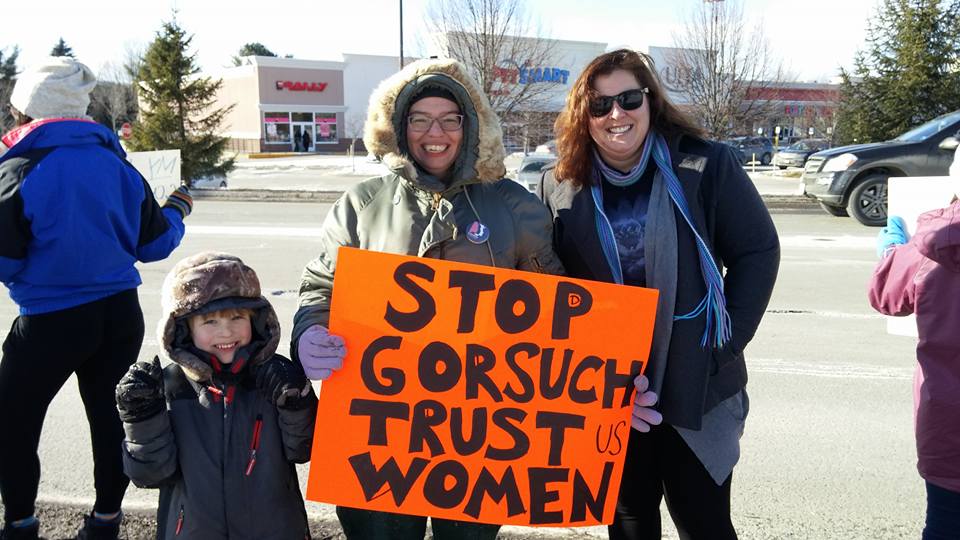
This time last year, Trump nominated anti-abortion judge Neil Gorsuch to the Supreme Court, kicking off a flurry of similar, appointments to the judiciary, all poised to impact the constitutional landscape for decades to come.
The Trump slate is characterized by substantial evidence of opposition toward a woman’s right to safe and legal abortion, and in some cases, even birth control.
For example, Kyle Duncan has actively opposed basic reproductive rights; he supported Texas’ restrictions on abortion in Whole Woman’s Health, the most important case since Roe, restrictions that the Supreme Court found burdened women and increased the number of unsafe, self-administered abortions.
Matthew Kacsmaryk’s record is extremely hostile to women’s health, including opposition to Roe as precedent and laws to protect birth control access.
Perhaps most troubling is Mark Norris, who has vigorously fought to harm women, even going as far as supporting a law to criminalize and impose felony charges on physicians who perform abortions.
Efforts to strip health coverage from millions of Americans, give personhood to fetuses, and other atrocities have kept public attention elsewhere, but we must remain vigilant about judges. When we emerge from the rubble of the Trump presidency, laws can be overturned but judges with lifetime appointments will make decisions that impact our children and grandchildren.
Trump, however, is not solely responsible. The Senate’s — including Sen. Susan Collins — rubber stamping of the president’s nominees is unacceptable and dangerous.
We were both born post-Roe and grew up with the privilege and security that entails. Brave and willing abortion providers treated us with respect and trusted us to know what was best for our own lives. We each had abortions, and today are stronger, healthier and happier than had we been forced to parent against our will. For one of us, and many of our peers, this includes being a happier parent now.
Our mothers’ generation was forced into back alleys or flying out of the country, if they could afford it. Others lost their lives because of illegal, unsafe abortions. Those are dire stakes indeed.
Hundreds of women just like us come through the doors of Mabel Wadsworth Center each year to seek abortion care. Many are already parents and want to parent the children they already have. Others are in school or struggling to make ends meet and want to pursue education and career goals. Some are escaping abusive relationships or battling addiction.
The reasons don’t matter, however, because women in 2018 deserve to have the right to decide when and whether to parent.
The decision to have an abortion is one of the most intimate, personal decisions a person can make. The only people who should be making decisions that impact our health and lives are our medical providers and us — not politicians nor judges.
Abortion is safe, legal and necessary. The judicially protected right to abortion and birth control has been essential to our generation’s social and personal advancement. We will not go back.
We ask Collins and Sen. Angus King to commit to holding all judicial nominees to a standard of following precedent and protecting our constitutional rights. Any judicial nominee must be independent and able to separate personal beliefs from the rule of law as it applies to protecting women, people of color, LGBTQ people and others from discrimination and violence.
Trump’s efforts to stack the judiciary with ideologically driven nominees must be stopped.
Aislinn Canarr is a board member and serves on the advocacy committee of Mabel Wadsworth Center in Bangor. Andrea Irwin is executive director of the Center.