On this episode of Reproductive Left, our executive director, Andrea Irwin, joins us to discuss a new report by the Abortion Care Network titled: “Communities Need Clinics. She explains the importance of independent abortion care providers in communities across the United States and highlight what makes Mabel Wadsworth Center unique. We also discuss Medicaid expansion and abortion coverage. In our “Ask Mabel” segment, nurse practitioner, Lindsey Piper, joins to answer questions about birth control options.
At Mabel Wadsworth Center, our interns are responsible for updating the bulletin board in our waiting room once a month. Past topics have included healthy relationships, safer sex, abortion stories and more. In case you don’t have the chance to visit us during the month of August, we’ve decided to put the bulletin board online this month as well. Enjoy this post by our summer intern, Olivia Pennington, a Sociology student at the University of Maine.
It’s Long Acting Reversible Contraception!
Cool! So what does that mean? Let’s break it down:
LA: LONG acting! You can get coverage from three months to 12 years!
R: Reversible! If you decide you want to try another method or want to try to get pregnant you can easily do so!
C: Contraception = Birth Control!
Overall, a LARC is a super easy way to prevent pregnancy that can last for a very long time and can easily be reversed if you decide it’s no longer the best fit! LARCs are some of the most effective forms of birth control available, with an effectiveness rate of over 99%! Let’s take a look at some of the options!
The IUD:
More acronyms! This one stands for Intrauterine Device. It’s a little piece of plastic that gets inserted into your uterus. They come in two forms: Hormonal and Copper. The hormonal ones work by releasing progestin, a hormone that thickens your cervical mucus to prevent sperm from even entering your uterus and stops your eggs from even leaving your ovaries! Copper and sperm really don’t get along, so the copper IUD works by allowing your fallopian tubes and uterus to create a fluid that is toxic to sperm (cool right?) and as a bonus, if inserted up to five days after having unprotected sex the copper IUD actually works as an emergency contraceptive! Hormonal IUDs, depending on the brand, can last between three and six years and the copper IUD can last for 12 years. That’s a long time to be worry free!
It’s also called Nexplanon, it’s just a little rod that gets inserted under the skin of your upper arm. It slowly releases hormones that do basically the same thing that a hormonal IUD does, thickens your cervical mucus to stop sperm from getting in your uterus and prevents your eggs from leaving your ovaries. No eggs, no sperm, no pregnancy for up to four years! In addition, it’s great for people who can’t take estrogen.
The Shot:
This one’s pretty self-explanatory, it’s an injection of something called Depo-Provera (or Depo for short) and it works, yep you guessed it, by thickening your cervical mucus and by preventing your eggs from leaving your ovaries. You go to your doctor every three months (four times a year) and you’re covered! The shot is also great for people who can’t take estrogen!
All LARCs:
So now that we’ve talked about all the different kinds of LARCs let’s talk about what they all do. They all keep you covered for a really long time which is awesome, but if you ever changed your mind and wanted to try for a pregnancy all of these methods are completely reversible. Just because an IUD can last for 12 years doesn’t mean it has to.
One of the most important things to remember about LARCs is that while they are incredibly effective at preventing pregnancies they do not prevent sexually transmitted infections (STIs)! To protect against STIs make sure you combine your LARC with condoms.
On that note, LARCs are some of the most effective forms of birth control available to you. They are over 99% effective, that’s just about as good as it gets! Additionally, they’re great because they let you be a little spontaneous! LARCs are over 99% effective every day, which means there’s no need to worry if you forgot your pill this morning or forgot to buy condoms yesterday. You’re totally covered (from pregnancy remember, not STI’s, you might still need to buy condoms!) wherever or whenever!
They’re really easy to hide. If you’re someone who likes to keep your birth control method private these are the forms for you! These forms of birth control can be kept a secret between you and your health care provider.
Most health insurance plans will fully cover LARCs. If you have MaineCare, Medicare, or private insurance you will most likely be able to get a LARC at no cost to you! If you don’t have insurance let us know and we can help you find other ways to pay or get discounted LARCs.
So….
If you’re interested in a LARC the next question is how do you get one? If only there was a feminist, independent, local, sexual and reproductive health center in your area…..
Yep, you got it! If you’re considering a birth control that could last for years with over 99% effectiveness give us a call or set up an appointment! Our health care providers can talk to you about all the pros and cons of each form and then if you decide one of these methods is right for you, you can get it right here at the Mabel Wadsworth Center!
In this episode, we had the opportunity to interview Victoria Yeboah, a young African leader with the Mandela Washington Fellowship.
The Mandela Washington Fellowship for Young African Leaders is the flagship program of the Young African Leaders Initiative (YALI) that empowers young people through academic coursework, leadership training, and networking. It started in 2014 and this year, the Fellowship has provided 1,000 young leaders from Sub-Saharan Africa with the opportunity to hone their skills at a U.S. college or university with support for professional development after they return home.
The Fellows range in age from 25 to 35 and have established records of accomplishment in promoting innovation and positive impact in their organizations, institutions, communities, and countries. The Fellows represent a diverse group of leaders from 48 countries across Sub-Saharan Africa and 50 percent of Fellows are women. Each fellow is connected with a local leader or organization for mentorship during the program. We had the privilege of being paired with Victoria Yeboah, a midwife and NGO leader who provides sexual and reproductive health education in Wenchi, a rural town in Ghana.
In our “Ask Mabel” segment, Terry Marley-DeRosier, WHNP answers a very common question about bodies after childbirth.
We know that transgender active service and veterans of the military are members of our community. We support you and we are so grateful for your service. Your bravery and strength to fight for our freedom abroad and for other nations, while also facing unimaginable hatred and bigotry from your own, is truly remarkable.
To all of our transgender friends, clients, supporters, and volunteers, you are not alone. We will continue to speak up and speak out to assure your safety, health, and dignity. We honor the diverse, unique perspectives and experiences you bring to our community. You make our health center a better and more inclusive place for all. You challenge us to consider our own privilege as we learn and strive to be strong allies.
It is hard to put into words how angry and heartsick this recent tweet has made us. But we will not stay silent. This administration and those who support it are putting our nation’s security at risk and unraveling decades of progress. This is unacceptable. Openly discriminating against the transgender community should not be used as a political ploy to distract from efforts to take healthcare away from millions of people. We must continue to resist. We will deepen our commitment to seeking justice for the transgender community and work harder.
For those who need a safe space and to feel supported during this time, we invite you to reach out to us. We are your allies and will continue to stand alongside you no matter what. We celebrate you and all you do to make our world a better, richer place.
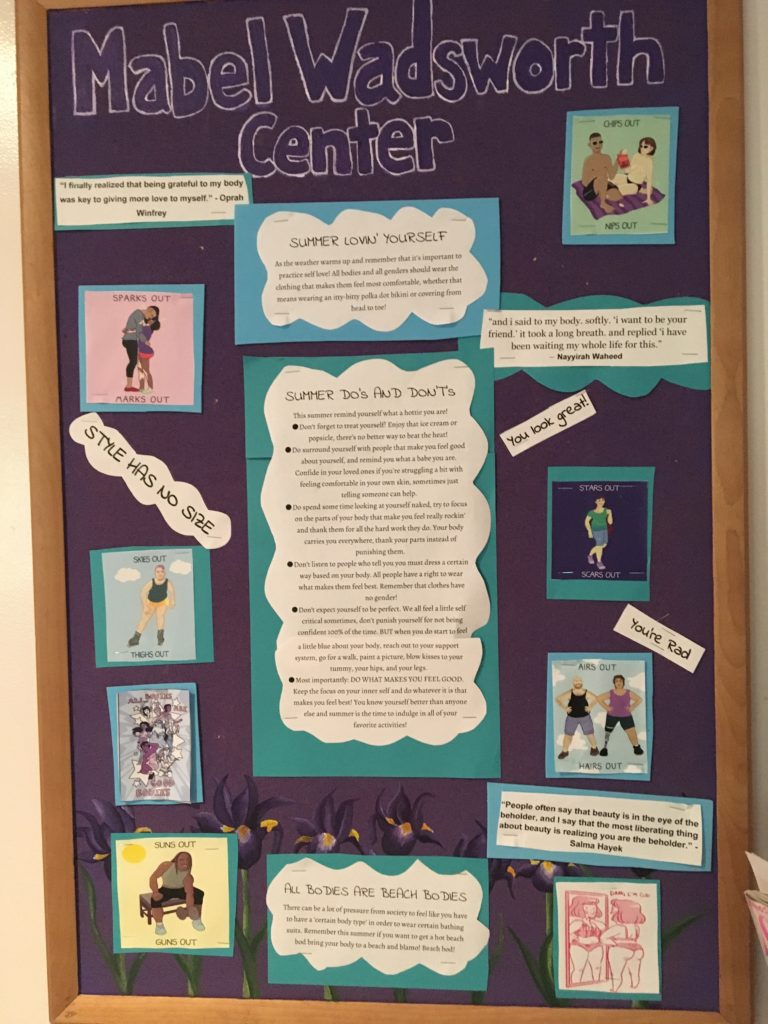
At Mabel Wadsworth Center, our interns are responsible for updating the bulletin board in our waiting room once a month. Past topics have included healthy relationships, safer sex, abortion stories and more. In case you don’t have the chance to visit us during the month of July, we’ve decided to put the bulletin board online this month as well. Enjoy this post by our summer intern, Olivia Pennington, a Sociology student at the University of Maine.
We at Mabel Wadsworth are so excited for warmer weather, beach days, and enjoying the beautiful Maine outdoors. As the weather warms up and we start being able to unbundle from our winter layers, we want to remind you that summer means wearing whatever makes you most comfortable. There is no pressure to find a bathing suit or a sundress or a crop top that “suits your body type.” You are allowed to wear the clothing that makes you feel great. People of all genders and of all sizes should feel comfortable wearing the clothes that they wish.
You deserve to have an excellent summer, and that starts with feeling excellent! However, we understand that it isn’t always easy to stay positive and sometimes you need a little help. That’s why we have devised a list of summer do’s and don’ts to help you stay feeling your very best.
For starters, do make sure you enjoy all the treats that you want to! There’s no better way to cool down after a hot day in the sun than with an ice cream cone or a popsicle. Make sure you treat yourself! Summer is about indulging and being happy, so if that mint chocolate chip cone with sprinkles on top makes you happy then go for it!
Secondly, do choose to spend your time with people that make you feel good about yourself. Your friends should be your support group, they should lift you up not tear you down. Confide in your support group when you’re feeling a little down, sometimes it can be really helpful just to tell someone how you’re feeling, and they may know just the way to lift you back up!
Don’t listen to the people that make unnecessary comments about your body. If a friend or family member is telling you something that makes you feel less than superb remember that it is your body and you have the right to present it however you want. Remember that clothing has no gender and style has no size.
Don’t expect yourself to be perfect. We all feel a little self-critical at times and that’s okay. The important thing is what you do when you feel down. Maybe try to focus on something you love doing like painting, drawing, going for a walk, singing your favorite songs in the car, or eating an ice cream! Confide in your support group, let them know how you’re feeling, you don’t have to carry that burden alone. Make a list of things you love about yourself, both about your physical appearance and your personality.
Do spend a little time naked. Try to notice and appreciate every part of your body that makes you feel awesome. Try to thank your body for all the hard work it does! Notice the way your hips move, notice the strength in your legs, notice the little freckles, stretch marks, or scars. There is no pressure to all of a sudden love all of your parts or little marks, but the more you spend time with your own body the more you will be comfortable with it. Try talking to your body the way you would talk to your best friend.
Above all else, do whatever it is that makes you feel good. Wear the clothes that you like, eat the food that you like, dance the way you want to, give yourself permission to feel comfortable in your own body. Remember that your body is a good body and you are allowed to show it off or cover it up however makes you feel best! Your health is important to us, and that starts with ensuring that you are feeling your very best and nourishing yourself with the self-love you deserve. Befriend your own body and give yourself the best summer yet. This summer let’s celebrate ourselves and those around us: all bodies are good bodies!