With Election Day just around the corner, on this episode, we are talking about women in leadership and the importance of voting. Here with me today is Bangor City Councilor Sarah Nichols. After successfully completing the Emerge Maine training program for Democratic women candidates, Sarah was elected for the first time to public office after winning a 7-way citywide race in November of 2015. Born and raised in Bangor, she studied New Media at the University of Maine and currently works for three feminist organizations: Maine Women’s Lobby, Hardy Girls Healthy Women, and Mabel Wadsworth Center. Additionally, Sarah currently serves on the Emerge Maine Board of Directors. When she isn’t working to better the lives of all women and girls you will find her cross-country skiing, hiking, traveling abroad, or enjoying a local beer at her favorite bar, Nocturnem Draft Haus. She talks about why she ran for office, what it is like being the only woman on the council, and she offers some advice for other women who want to run!
After our discussion with Councilor Nichols, one of our current interns, Meghan Frisard, from the University of Maine will be joining to talk about when, how and why to vote this year. Be sure to stick around until the end for our “Ask Mabel” segment where Nurse Practitioner Terry Marley-DeRosier answers your sexual and reproductive health questions!
At Mabel Wadsworth Center, our interns are responsible for updating the bulletin board in our waiting room once a month. Past topics have included healthy relationships, safer sex, abortion stories and more. In case you didn’t have the chance to visit us during the month of October, we’ve decided to put the bulletin board online as well. Enjoy this post by our fall intern, Meghan Frisard, a student at the University of Maine.
Question 2, an effort to expand MaineCare (Medicaid) to 80,000 people will be on the ballot in the Maine election on November 7th, 2017. Mabel Wadsworth Center is a part of Mainers for Healthcare and endorses ‘YES’ on question 2.
What is Question 2?
A ‘yes’ vote is a vote to expand MaineCare. What does it mean to expand MaineCare? The rule for who is and is not covered under Medicaid depends on each state. 31 other states have already expanded their Medicaid programs. Currently, there are thousands of Mainers who do not qualify for MaineCare and cannot afford quality private health insurance. As a result, they may end up delaying care and then ending up needing care from hospital emergency departments, making the entire health system less efficient and more expensive for all of us. If Question 2, passes Mainecare will expand coverage and increase access to preventative care. Improving access to preventative care and other services will also allow rural hospitals to stay open and thus create more jobs in these rural parts of the state, where jobs are needed.
If you want to learn more, you can see the impact question 2 will have on our entire state or by county. MaineCare expansion is especially important to women, the LGBTQ community, people of color, and those experiencing sexual assault or domestic violence. All of these vulnerable populations are more likely to be living in poverty and therefore in need of healthcare. This program would also support our hospitals, community health centers and other providers like Mabel Wadsworth Center. We know firsthand how devastating a lack of healthcare can be on our clients.
When, Where, and How can I vote on Question 2?
Election day is Tuesday, November 7th, 2017. Your polling location depends on where you live. You can use this portal to see what your polling location is and what its hours are on Election Day.
How do I register to vote?
You can register by mail up to 21 days before the election, and any day leading up to Election Day in person. You can register in person at your town/city office or at any Department or Registry of Motor Vehicles branch. In Maine, you can also register at the polling station on Election Day – be sure to bring proof of residency in the town/city that you are registering in. Proof of residency includes a ME driver’s license with a current address, a utility bill, etc.
I work on Tuesdays or have other obligations. Can I still vote?
Yes! You can either get an absentee ballot or vote early. Absentee ballots for this election must be received no later than 8 pm on Election Day (November 7th). You can request your absentee ballot here: http://www.maine.gov/cgi-bin/online/AbsenteeBallot/index.pl. You can also vote in person by absentee at your town clerk’s office as soon as the absentee ballots are available, which is at least 30 days before the election.
Why should I vote in this election? No representatives or legislators are getting elected.
Every election is important, and something is always at stake. Your vote in this November election could decide whether or not someone gets the healthcare that they need. You can vote by absentee ballot early, so you don’t have to miss work, school, or family time to vote. In the presidential election last fall, 72.8% of Mainers voted, making us the state with the second highest voter turnout in the country. Let’s keep that momentum up and VOTE!
On this episode, we talk with Sharon Barker, co-founder of Mabel Wadsworth Center and former director of the University of Maine’s Women’s Resource Center. Shortly after Sharon retired from the University of Maine, the Women’s Resource Center (WRC) abruptly closed. Due to committed student activists, the WRC has reopened without a director or a budget. Sharon explains what happened to the Women’s Resource Center and why it was so important. We also discuss the overall landscape of women in higher education. In our “ask Mabel” segment, Terry Marley-DeRosier explains the cause and remedies of dysmenorrhea or painful periods.
At Mabel Wadsworth Center, our interns are responsible for updating the bulletin board in our waiting room once a month. Past topics have included healthy relationships, safer sex, abortion stories and more. In case you didn’t have the chance to visit us during the month of September, we’ve decided to put the bulletin board online as well. Enjoy this post by our fall intern, Meghan Frisard, a student at the University of Maine.
Health insurance is a super complicated topic, but something that every American needs to know about. There are a lot of sources of misinformation out there, and we are here to break down the key features of health insurance, and what Mainers need to know to make sure that their healthcare needs are covered!
Let’s start with the basics. What is health insurance?
Health insurance is a system that individuals pay into that helps them pay for medical expenses. It is similar to car insurance, something people are often more familiar with that’s a little less complicated; you pay a monthly car insurance bill even if you are a safe driver and have never been in an accident, and your car insurance company will then pay to fix your car if you get in an accident or crack your windshield. Similarly, you pay into your health insurance even when you are healthy, and then your insurance company covers your health services as you need them.The biggest difference is that car insurance companies do not pay for preventative maintenance, while most health insurance companies do! They often cover preventative services (regular check-ups, pap smears, etc) because catching a problem early will almost always lead to a better outcome for you and less expenses for them, as opposed to having to cover long hospital stays or surgeries.
What is a premium? copay? A deductible? Coinsurance?
A premium is what you pay for insurance every month.
A deductible is what you pay for health services before your insurance kicks in and pays for services until you hit your maximum out of pocket amount.
A copay is a fixed amount that you pay for certain services, such as prescription drugs or doctors visits, until you hit your maximum out of pocket amount.
Coinsurance is a certain percentage of covered services that you will pay until you hit your maximum out of pocket amount.
Your maximum out of pocket amount is the maximum amount of money that you would pay for services in a year. Copays, coinsurance, and money paid towards your deductible all count towards this amount. Your monthly premiums, however, do not count towards this amount.
A lower premium will result in a lesser monthly bill, but low premiums often are paired with high deductibles, which means you will be paying more for services. Lower premiums also often have higher maximum out of pocket amounts.
If you have listened to, watched, or read any news media over the past 7 years, you have probably heard about The Affordable Care Act, also known as Obamacare. What is Obamacare?
The Affordable Care Act (ACA) is a major piece of legislation passed in 2010. Some of the key features of the ACA are:
required insurance companies to cover essential health benefits which include: preventive care, hospitalization, maternity and newborn care, emergency-room care, and broader prescription drug coverage.
Required all Americans to have health insurance or face a tax penalty, and offered subsidies and expanded Medicaid for low-income Americans, to offset the costs of being required to have health insurance.
Allowed young people to stay on their parent’s insurance until they are 26.
Prevented insurance companies from denying coverage based on preexisting conditions (such as diabetes, cancer, childbirth, or other common but expensive conditions)
Required insurance companies to charge women the same rates as men.
Prevented insurance companies from charging older consumers drastically more than younger consumers. Insurers cannot charge older consumers more than 3x the rate of younger consumers, but before the ACA older consumers were being charged as much as 10x more than younger consumers.
Required employers to offer adequate insurance to employees, and offered options for employees who could not afford the insurance offered by their employers
If you’re already covered by insurance purchased from healthcare.gov as part of the ACA (Obamacare), you need to reapply each year, or you will lose coverage. Open enrollment for ACA Marketplace insurance begins November 1st, 2017 – December 15th, 2017.
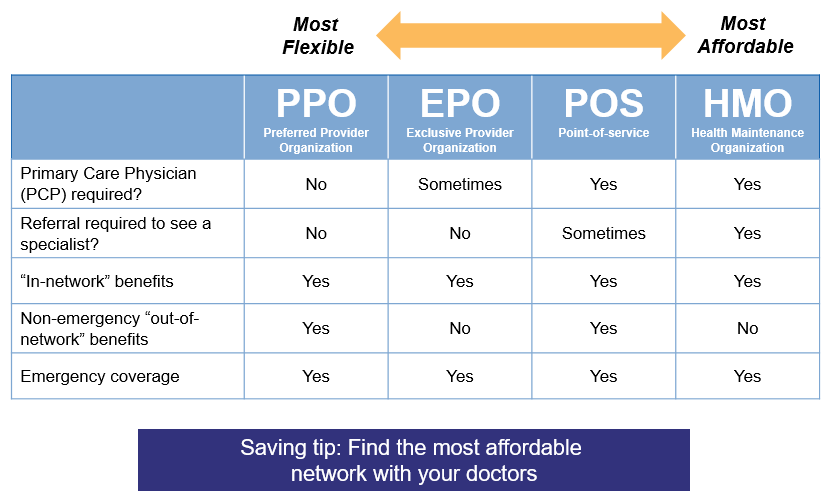
Do you have (or want) private insurance from the ACA Marketplace, an employer, or elsewhere? What is the best option? What is an HMO? A PPO? EPO? POS?
All of these are different types of health insurance plans that offer you more or less flexibility in choosing the healthcare providers that you see. The terms “in-network” and “out-of-network” refer to the so-called network of providers that your insurance company has agreed to work with for your plan. If you choose a plan that only allows in-network providers, make sure that your provider is part of the network before you go in for a visit because otherwise your services may not be covered and you could get a large bill! This infographic from TakeCommandHealth shows the differences between different insurance plans, but make sure to read your own policy closely to see what services are covered.
Some people in Maine have health insurance through MaineCare but may not know what it is. What is MaineCare? Medicaid? Medicare?
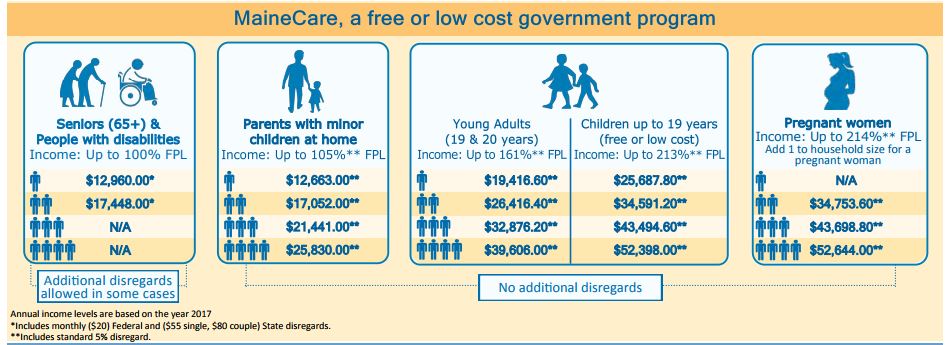
Medicaid is government-funded health insurance for people who fit certain categories and are eligible based on income. In Maine, Medicaid is called MaineCare. What your MaineCare plan covers depends on age, family size, health care needs, and other variables. In terms of sexual and reproductive health, MaineCare covers ultrasounds, pap smears, mammograms (which you can get a referral for from Mabel’s), pregnancy, and birth control. MaineCare does not cover abortion services, but Mabel’s can help you find other ways to pay if you need an abortion and are covered by MaineCare. Check out this infographic from Maine Equal Justice Partners to see if you qualify for MaineCare. If you still have questions, you can call the Consumers for Affordable Health Care Help Line: 1-800-956-7476.
Medicare is a federally funded health insurance program for people who are 65 or older. Medicare has 4 parts: Part A (Hospital Insurance), Part B (Medical Insurance), Part C (Medicare Advantage Plans), and Part D (Prescription Drug Coverage).
Part A covers inpatient hospital care, and most people who are 65 or older get Part A for premium-free when they turn 65, but still are responsible for copayments, coinsurance, and deductibles.
Part B covers doctors visits, outpatient hospital services, and other medical visits. All people who are eligible get Part B and pay a deductible and a monthly premium.
Part C covers everything that A and B cover and most Part C plans also include prescription drug coverage (part D).
Part D covers the cost of prescription drugs. There are many Medicare Part D plans and each has a different amount and type of drugs that they cover, so make sure to look carefully at the medications you take to ensure that you select a plan that covers them.
The Center strongly supports the ACLU’s lawsuit to challenge a medically unnecessary abortion restriction that burdens Maine women, especially young women, women of color, and women with low income. The current law singles out abortion as the only health care service advanced practice registered nurses (APRNs) are banned from providing, despite their rigorous post-graduate training and extensive clinical experience providing a broad range of comparable services. It prevents many qualified, trained APRNs from providing abortion, leading to a shortage of medical providers of abortion care in our communities.
As Maine’s first publicly available abortion provider, and only provider of the procedure north of Augusta, we know how challenging it can be for women in rural communities to access safe, quality abortion care. If this lawsuit is successful, Mabel Wadsworth Center will be able to greatly expand the availability of abortion care in northern and eastern Maine.
We also know that abortion can be provided safely and effectively by APRNs, including nurse practitioners. Numerous medical authorities ranging from the American College of Obstetricians and Gynecologists, to the American Public Health Association, to the World Health Organization have all concluded that laws prohibiting APRNs from providing first-trimester abortion services are medically unfounded.
Mabel’s was founded by and has always been led by and staffed by nurse practitioners. We firmly believe in nurse practitioners’ ability to provide quality, client-centered healthcare. Co-founder Terry Marley DeRosier, certified women’s health nurse practitioner, is celebrating her 20th year of service at Mabel’s this month, and has provided exceptional healthcare in Bangor for more than three decades! Our other provider Lindsey Piper, CWHNP, has more than 15 years of experience in women’s health. She practiced abortion care while working in other states and pursued a nursing career so she could provide abortion care. Both are qualified clinicians that always put the needs of their clients front and center. They are also passionate about ensuring our clients are able to receive abortion care, prenatal care, and other sexual and reproductive health services.
Please join us in celebrating the critical role of nurse practitioners and this proactive case to end a stigmatizing and unnecessary restriction on abortion access in Maine, and potentially open the door for other states to follow.