
Historical Parallels Between Witch Hunts and the Anti-Abortion Movement
by Nnenaya Bloomstein (she/her) Williams College Women’s, Gender, and Sexuality Studies student and Mabel Wadsworth Center intern
Today in the United States, actions are taken every day by politicians and right-wing activists to restrict access to abortion. One of the most recent major actions was taken by politicians in the state of Louisiana who filed a lawsuit against the FDA in an attempt to prevent the mailing of the drug mifepristone. If passed, this law would require in-person appointments to receive this medication, even in states where there are no laws against abortion. It’s important to note that medication abortion provided through the mail has been proven to be safe and effective (Grossman, Raifman, and Morris 2024). Although the Supreme Court halted this ruling, sending it back for review, this action has extremely dangerous implications, one of which is a full abortion ban across the United States (Serwer 2026). As most who advocate for access to abortion know, the anti-abortion movement has nothing to do with protecting the lives of those who can become pregnant. Instead, it’s about controlling these bodies and in doing so forcing them to conform to an established norm. Part of this norm is the idea that people with uteruses are biologically predetermined to be mothers. While rhetorics like this can often feel as if we are living in an unprecedented time of attacks on access to reproductive rights, this is far from the truth. Attitudes towards abortions have shifted greatly across time, and anti-abortion sentiments are simultaneously new and not unheard of. Today I’d like to take us back roughly 500 years ago to think about witches. Although they aren’t often thought of as having any connection to reproductive justice, the witchcraft trials and hunts of the early modern period can teach us a great deal about how women’s bodies have been managed throughout history and how witches, just by existing, resisted the attacks on their bodies.
The early modern period, characteristically thought of as the era between the 1500s and 1800s, was a time in which witchcraft accusations and witch-hunts were rampant throughout western Europe and the United States due to colonization (Weisner 2008). The targets of these witchcraft prosecutions varied regionally and throughout time. But to put it generally, witches were people who acted in out-of-character ways, people who caused harm to others, people who kept strange pets, and, if you could prove it, people who made pacts with the devil. While anyone could be accused of witchcraft, gender identity also became an important qualifier for this accusation. As most people know, the majority of those accused of being witches were women. Part of the reason why women were more likely to be accused had to do with the ways women’s behaviors were regulated by both political and religious powers in the early modern period (Weisner 2008).
The most widely supported belief about women and their sexualities was that they were inherently sinful. Because women had such strong sinful tendencies, they were expected to be pure, chaste, innocent, and above all else to be submissive wives and mothers (Gowing 2012). As a result, when women became the targets of witchcraft accusations, it had less to do with them actually perpetrating harmful magic and more to do with their lack of conformance to the idealized femininity of the early modern period. The story of Elizabeth Frauncis, a witch in the first ever published witchcraft pamphlet, supports the significance of conformity for early modern women. After having sex with a man outside of marriage, her first sinful act, she becomes pregnant. But when this man realizes that she is pregnant, he leaves her and Elizabeth is said to have “destroyed the child forthwyth” (Gibson 2000). Meaning, in very judgmental old English terms, that she used the power she was given from Satan to have an abortion. In this, and all of the crimes Elizabeth commits, she fails to conform to the femininity that was expected of her. She is not only impure and sexually lewd, she fails at being a mother, the thing that was most important to early modern women’s identities. This pamphlet makes it clear that Elizabeth’s true crimes are choosing what she wanted to do with her body and in doing so, deviating from normative femininity.
Punishing women for doing things for their bodies that are not considered “normal” sounds eerily familiar. Despite coming a long way from the rigid expectations for early modern women, contemporary women and everyone who can give birth, are still judged within the same framework that places value on motherhood and child-bearing above all else. Despite there being so many more opportunities for women, the importance of motherhood feels deeply entrenched into our identities. As women gain more control over their lives and choose to engage in practices that do not align with the idealized mother and wife, it seems as though our reproductive rights are only diminishing. Rather than being celebrated for our independence, women across the country are being punished just as Elizabeth and the thousands of other witches were in early modern times. This punishment reinforces the idea that motherhood is an essential part of womanhood and that our bodies and our choices are not truly ours.
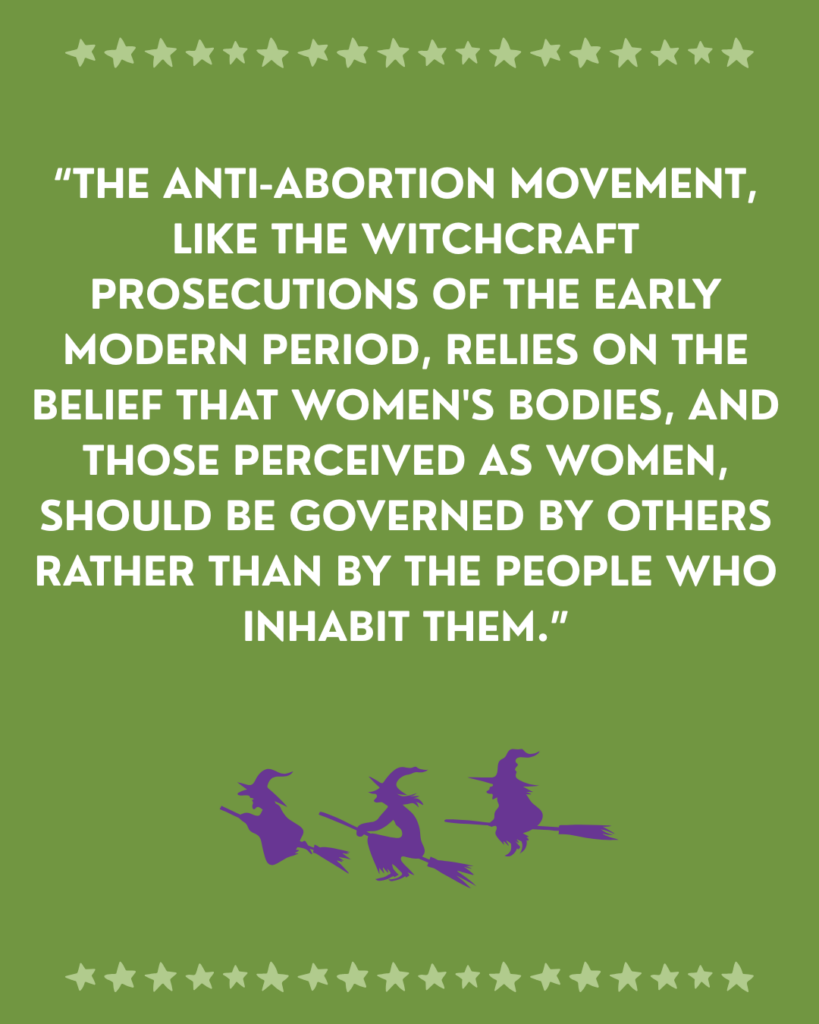 While there are many ways to analyze and understand witches throughout history, where I think we can find the most power in their history is by thinking about how witches are connected to our everyday lives. The way they were treated was not just about protecting communities and weeding the devil out of society; it was about controlling women’s choices and to ensure they remained submissive wives. The anti-abortion movement, like the witchcraft prosecutions of the early modern period, relies on the belief that women’s bodies and those perceived as women should be governed by others rather than by the people who inhabit them. While women like Elizabeth were imprisoned for their defiance, their resistance to their roles means so much more than their punishment. Their stories are reminders that sexual deviance and queerness have always existed in many different forms. Understanding this history allows us to see contemporary attacks on reproductive rights not as isolated political disputes, but as part of an enduring effort to control who gets to make decisions about their own body.
References
Gibson, Marion, “The Examination and Confession of certaine Wytches (1566).” In Early Modern Witches: Witchcraft Cases in Contemporary Writing. Psychology Press, 2000.
Laura, Gowing, ‘Women’s Bodies and the Making of Sex in Seventeenth-Century England,’ Signs: Journal of Women in Culture and Society, 37:4 (2012): 813-822. https://www.journals.uchicago.edu/doi/epdf/10.1086/664469.
Serwer, Adam. “So Much for Leaving Abortion Up to the States.” In The Atlantic, 2026. https://www.theatlantic.com/ideas/2026/06/mifepristone-abortion-pill-access-impossible/687519/.
Wiesner, Merry E. “Ideas and Laws Regarding Women.” In Women and Gender in Early Modern Europe. Cambridge University Press, 2008. https://archive.org/details/womengenderinear0000wies.
Grossman D, Raifman S, and Morris N. “Mail-Order Pharmacy Dispensing of Mifepristone for Medication Abortion After In-Person Screening.” In JAMA Internal Medicine, 184:8 (2024): 873-881. https://www.ansirh.org/research/research/abortion-pills-mail-are-safe-and-effective-study-shows